


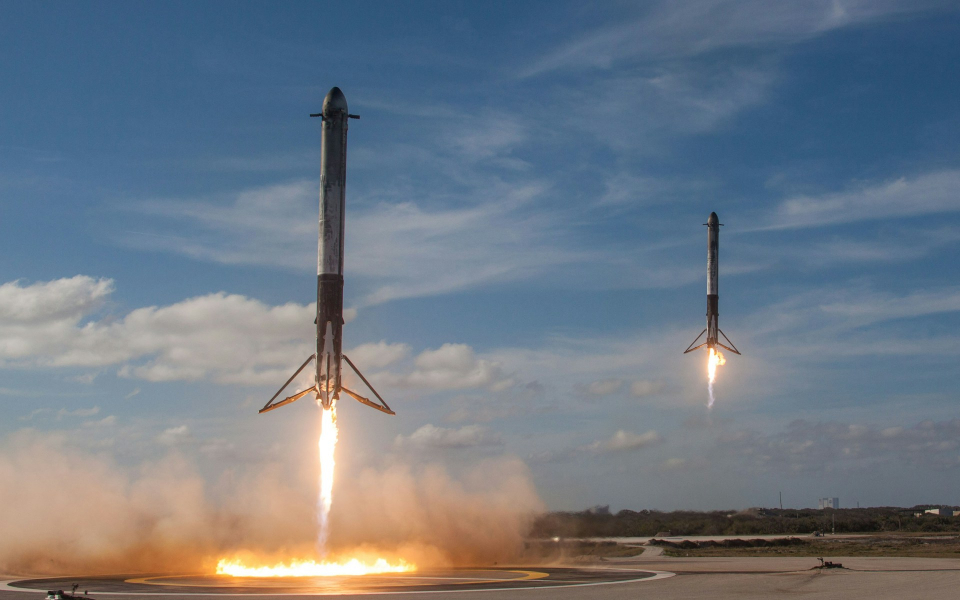
Elon Musk's rocket company SpaceX
Yet, some investors wanted no part of it.
SpaceX priced its initial public offering at $135 a share late Thursday, selling 555.56 million shares to raise $75 billion at a valuation of about $1.77 trillion.
The deal is roughly 2.5 times the size of Saudi Aramco's December 2019 listing, the previous record, and lands Musk's company among the 10 most valuable listed companies on earth.
Shares begin trading on the Nasdaq on Friday.
Total demand reached around $250 billion, leaving the offering nearly four times oversubscribed, with BlackRock Inc. alone reported to have placed a $5 billion order.
What History Says About Paying Up For Growth
Sean Peche, portfolio manager at Ranmore Fund Management, said investors should be wary of paying excessive prices for compelling growth narratives.
"The maths of overpaying for growth and quality can be very destructive to your wealth," Peche said, pointing to historical examples where highly successful companies still generated disappointing returns for shareholders who bought at elevated valuations.
Peche frames the risk through a company nobody would call a failure: Pfizer Inc.
An investor who bought the drugmaker in April 1998, before Lipitor and its COVID-19 vaccine generated hundreds of billions in combined sales, would still be sitting on a negative total return 28 years later, he said. Buy in June 2000, after the Warner-Lambert deal, and the loss deepens.
"The Pfizer example explains why value investors like us will look elsewhere for investment opportunities," Peche said.
"Stories are about the past, but it's the future that kills you," Peche added.
Forecasting five years of growth is close to impossible, he argued, and when the growth rate stumbles for some unforeseen reason, the de-rating tends to be worse than investors expect.
His objection to SpaceX is the multiple. At about $1.77 trillion against $18.67 billion in revenue last year, the company is being valued at nearly 100 times sales rather than earnings, a level that bakes years of flawless execution into day one.
SpaceX is still loss-making, reporting a net loss of $4.28 billion in the first quarter even as revenue rose 15% to $4.69 billion.
A Satellite Business Wrapped In An AI Premium
Ismael García Puente, deputy director of investment strategy at MAPFRE Asset Management, draws a sharper line between what investors pay for and what they actually buy.
Today, he said, SpaceX is fundamentally a satellite-launch business, and that remains its largest source of revenue.
The newer technology and artificial-intelligence operations, which carry much of the valuation, are not yet profitable.
"Its technology and AI-related businesses are still operating at a loss," García Puente said.
So Is SPCX Worth The Premium?
The split is the whole story.
Some investors see a once-in-a-generation platform spanning launch, satellite internet and AI compute, fused with xAI in a recent merger. Value investors see a price that already assumes most of that works.
Markets rotate toward narratives like this one, and they rotate away again when the numbers arrive. Whether SpaceX rewards the buyers who paid 100 times sales on day one rests on a question no prospectus can answer: not whether Musk can build the future, but whether that future can ever earn enough to justify what investors paid for it today.